

Spend a few minutes on Instagram or TikTok, and you will see an entirely new language of hair care. Clients are watching videos about rosemary oil that is “better than minoxidil”, onion juice rinses for regrowth, caffeine shampoos that “wake up” follicles, DIY scalp cocktails and “natural” routines that promise transformations in a matter of weeks. For clients, this can feel hopeful and empowering, but for salon teams, it often feels like a consultation minefield.
In her latest Colourstart Edge session, trichologist Jacky van Driel unpacked the science behind these trending ingredients and the claims that surround them. We’ve taken that one step further and consider how this finds its way into the salon, where fiction becomes reality. When a TikTok-influenced client is in the chair, the pressure is on the hairdresser to give quick answers while keeping every service safe and professional. How can stylists navigate this new and rapidly changing landscape with confidence rather than fear? Who can they trust? We want to earn your trust that Colourstart Edge is the resource you can rely on to help.
One simple framework Jacky looks at in her video is the three levels of the hair.
First there is the hair fibre, the visible strand with cuticle and cortex. This is where bond builders, hydrolysed proteins, oils, silicones and other conditioning agents do their work. They can improve smoothness and shine, reduce breakage and help the hair feel stronger, but they cannot repair split ends or change how fast hair grows.
Second there is the scalp, which Jacky describes as the environment. It is skin, with a barrier and microbiome just like the rest of the body, and it stretches from the hairline over the whole head. Ingredients such as prebiotics, probiotics, niacinamide, caffeine and soothing plant extracts tend to work at this level, where they can calm itching and redness, support barrier function and improve comfort.
Third there is the follicle, inside the skin, where hair actually grows and sheds. This level is influenced by blood supply, hormones, overall health, medication and nutrition and is where true hair growth decisions are made. Jacky reminds us that hair growth happens inside the body, not in the bathroom, so cosmetics alone cannot treat medical hair loss or override genetics or hormones.
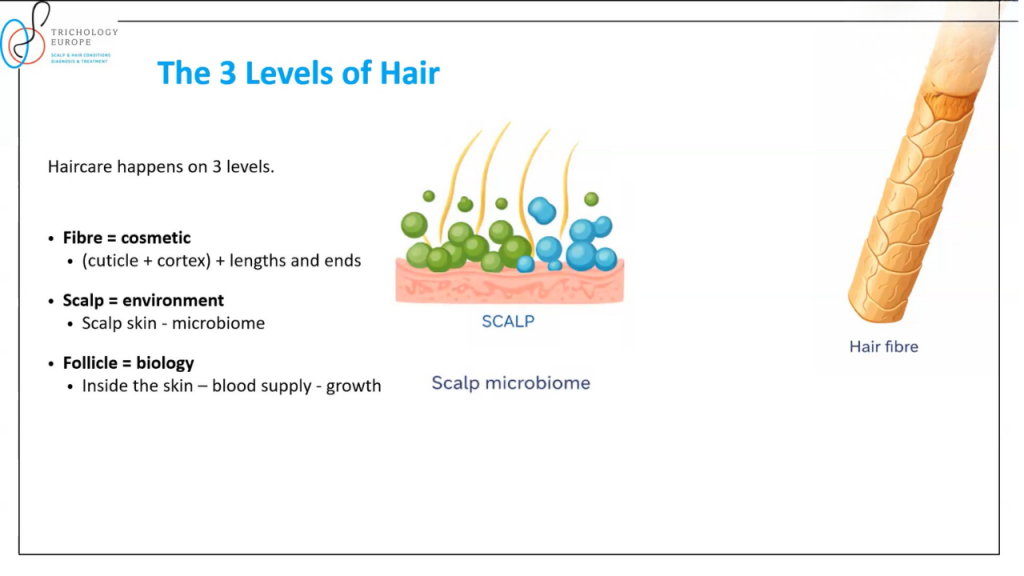
For stylists, this framework is extremely useful in consultation. When a client asks whether a shampoo or serum will “make hair grow”, you can explain which level that product actually reaches and what is realistic for it to achieve.
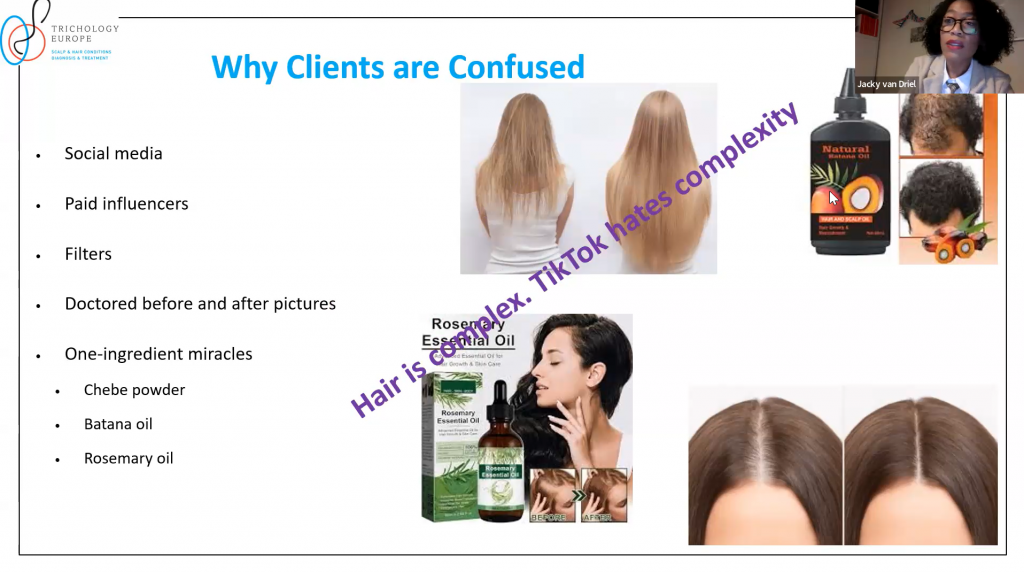
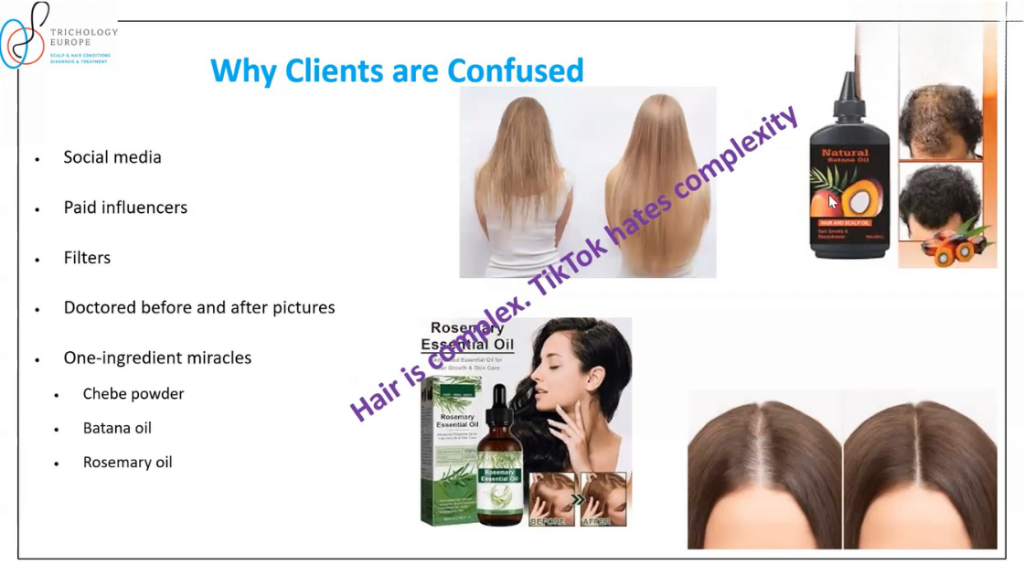
To open the session, Jacky showed a spoof influencer video. In it, her twin sister reviews a “miracle” product that supposedly transforms hair growth in just two days, complete with dramatic before and after claims and the classic claim that she is “not sponsored”. The audience quickly identified the problem. As hairdressers, they know that nothing can grow hair in two days or dramatically increase the natural rate of growth.
Clients do not have that professional background. They see short, edited clips, dramatic lighting and before and after images that are easier than ever to manipulate using artificial intelligence. Jacky is clear that not everything on TikTok is fake, but much of it is exaggerated and simplified to fit into a ninety-second video.
This is where the three-level model becomes a useful tool. You are not expected to be a biochemist, but you can explain that ingredients can make hair and scalp feel and look better at the cosmetic level and can support a healthier environment, but they cannot cure baldness or take the place of medical treatments. The distinction between cosmetic ingredients and medications is central and dosage is often the key difference.
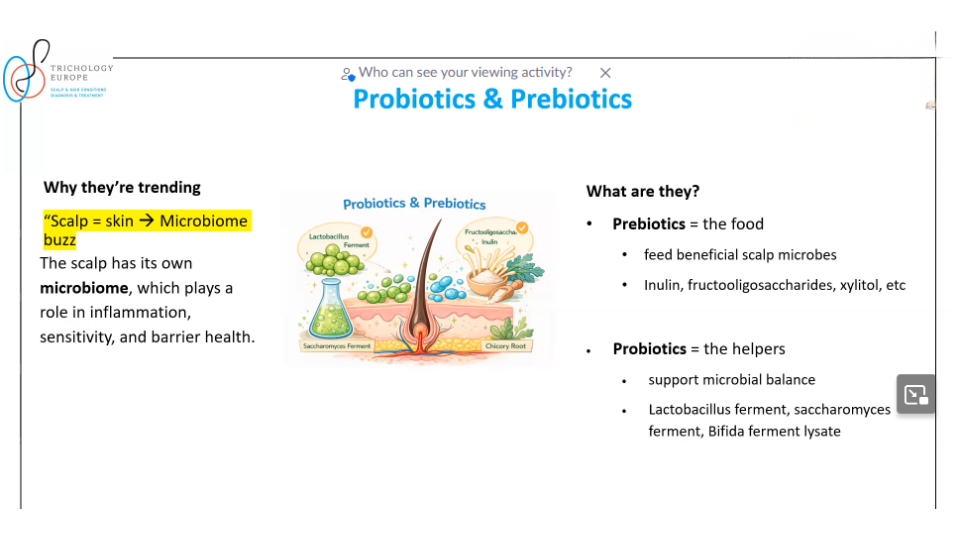
One of the strongest trends Jacky sees in clinic is the “skinification” of hair. Brands now talk about scalp microbiome, prebiotics, probiotics and barrier health in the same way skincare brands talk about the face. This is not pure marketing. The scalp has its own community of microorganisms, including bacteria and fungi such as Malassezia, which usually live with us harmlessly.
Prebiotics are essentially food for beneficial microbes, often identifiable on labels as saccharides such as inulin, fructooligosaccharides or xylitol. Probiotics and related ferments, such as lactobacillus ferment or saccharomyces ferment, are there to support balance in that community. When the environment is optimal this microbiome can help protect against more harmful organisms, but when it is disturbed the result can be irritation, inflammation and even hair shedding.
These ingredients can reduce itching and redness and improve comfort for many clients. They help create healthy soil, to use Jacky’s analogy, but even healthy soil does not guarantee perfect flowers if there is a deeper medical problem in the body. It is therefore important to position microbiome focused products as supportive care, not as a standalone solution for hair loss.
Another theme that has resurfaced on social media is onion juice and garlic for hair growth. Jacky notes that she heard about this trend ten years ago and is now seeing it return on platforms such as TikTok. In theory there is a scientific basis. Certain sulphur-containing compounds derived from onions can help support keratin structure, provide antioxidant effects and mildly support circulation, which is why you may see onion extract listed on some product labels.
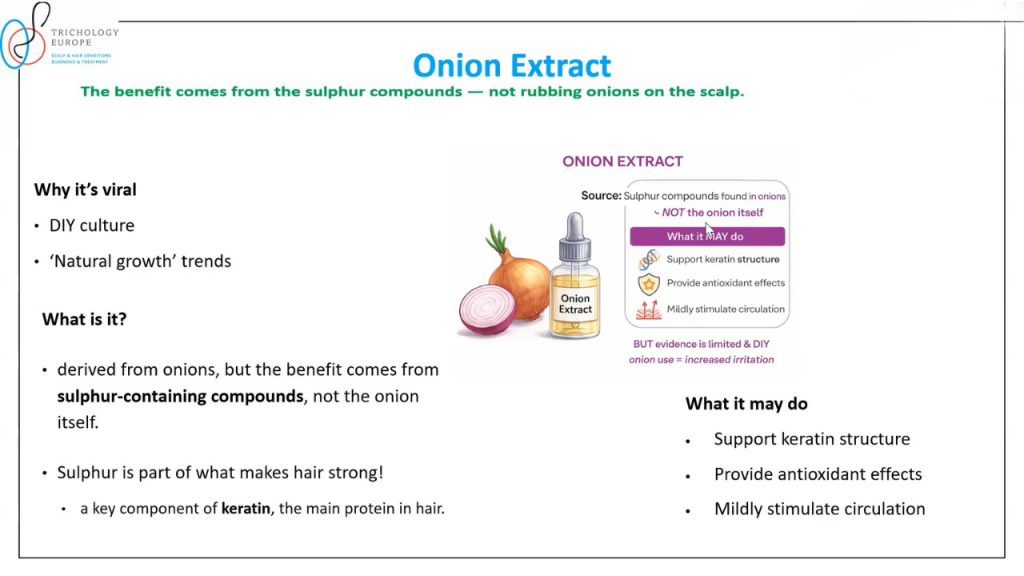
The problem is that social media skips straight to the kitchen. Clients are blending onions, sometimes with garlic, and applying the raw juice directly to their scalp in high concentrations. Jacky has seen clients arrive in clinic with severe irritation after following these home recipes. In addition, the extraction process needed to obtain the useful sulfur compounds in a stable way is different from simply juicing vegetables at home.
Her conclusion is that, in a well formulated product, carefully measured onion derived ingredients can play a supportive role, but do it yourself onion juice on the scalp is more likely to cause inflammation than hair growth. The same caution applies to the heavy use of raw oils on already inflamed scalps. Emollients can soften and protect but on an angry, red scalp they can feed inflammation rather than calm it.
For the salon this has very direct implications. Heavy oiling and home mixes increase the need for a visual scalp check at every colour appointment and for gentle questioning about recent changes in hair or scalp routines.
Caffeine shampoos have become a household concept. Marketing describes them as “coffee for your follicles”, promising to revive them and fight hair loss. Jacky explains that in laboratory studies, where isolated follicles are exposed to caffeine at specific concentrations, there is evidence of mild stimulation and some action against the hormone DHT, which is implicated in pattern hair loss.
However, those studies are done in petri dishes, not in the shower. In real products, caffeine is often present at much lower concentrations and contact time is short because shampoos are rinsed off after one to three minutes. Caffeine can therefore be a useful supporting ingredient in a gentle formula, especially if clients enjoy using it, but it is not a stand alone cure for androgenetic alopecia or significant shedding.
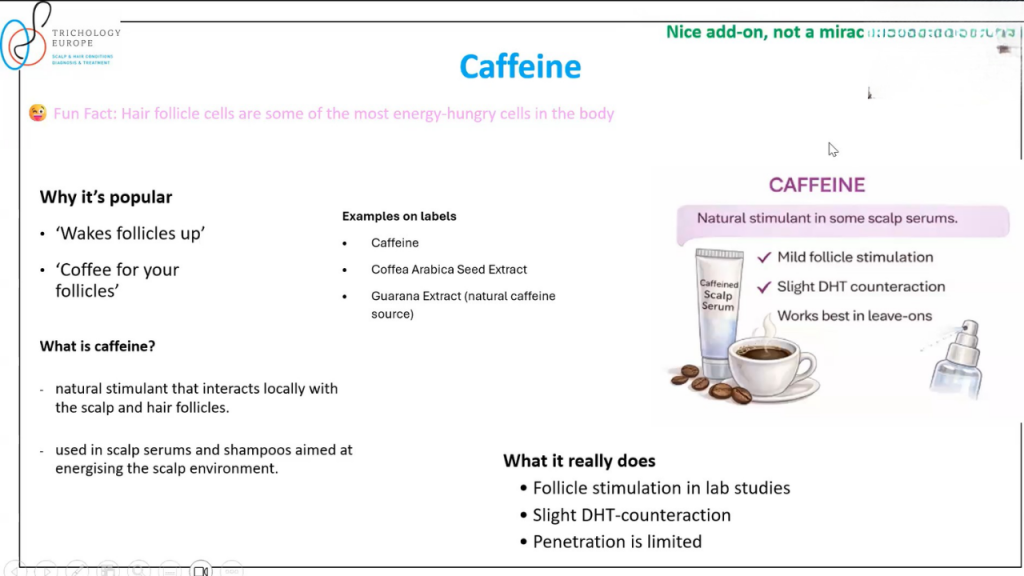
The key message Jacky shares is that you must first understand the type of hair loss and its cause. If the underlying issue has nothing to do with the pathway caffeine affects, then a caffeine shampoo will not help no matter how often someone uses it. Managing expectations and positioning caffeine as a minor supporting actor rather than the star of the show is crucial.
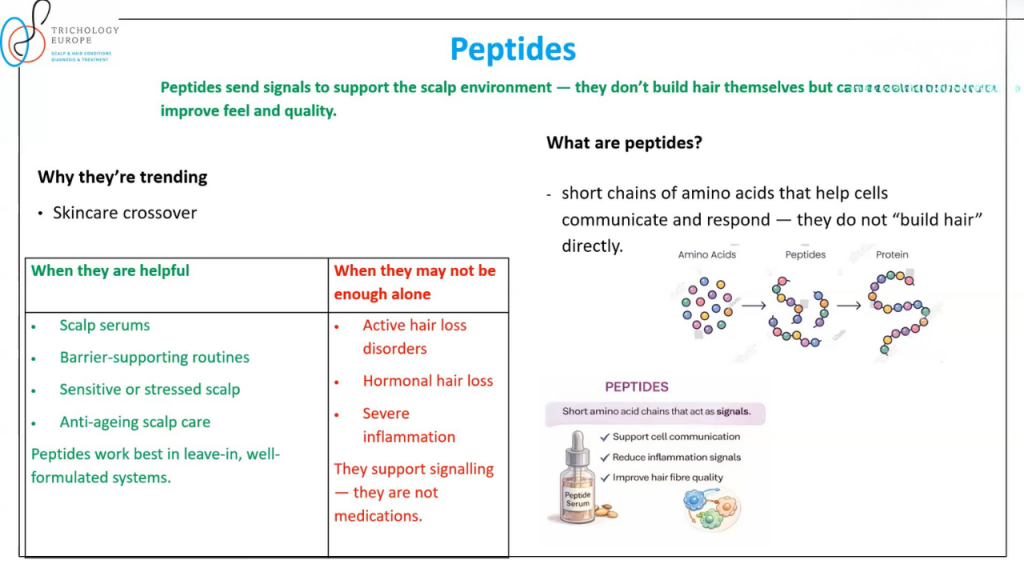
Peptides are another category that has moved from anti ageing skincare into hair and scalp products. Jacky defines them as short chains of amino acids, essentially partial proteins that help cells communicate and respond. They sit between single amino acids and full proteins, much like a beaded necklace that is only partly assembled.
On the scalp, peptide containing serums can support the barrier, helping sensitive or stressed skin recover and feel more comfortable. They work best in leave in formulations rather than in shampoos that are rinsed away quickly. For clients with mild sensitivity or those interested in “anti ageing” scalp care they can be a nice addition.
However, in active hair loss, severe inflammation or clearly hormonal conditions, topical peptides are unlikely to make a significant difference on their own. They support cellular signalling in the skin but they are not medications and cannot replace medical investigation where that is needed. Again, they should be described as part of a supportive environment rather than a direct hair growth solution.
Jacky spends time on ingredients that many clients are now told to avoid. Sulphates, for example, have become a common concern. They are the cleansing agents in many shampoos and are designed to remove oil and product build up effectively. Sodium lauryl sulphate and sodium laureth sulphate are the names clients most often notice on labels.
These molecules are powerful. On a healthy scalp and hair, particularly where there is heavy oiling or product use, they can provide the deep cleanse that is actually needed. They are also valuable for pre colour clarification when you want the hair fibre to be properly clean before applying colour. On the other hand, on very dry, inflamed scalps or severely compromised hair, the same strength can feel harsh and aggravating.
Jacky’s perspective is that sulfates are neither inherently good nor inherently bad. They are powerful tools and power needs context. When used at the right time, on the right head, they offer clear benefits. When used without regard for existing sensitivity they can cause problems, in the same way that a moderate glass of red wine can support health but a bottle every night is harmful.
Emollients, including butters, oils, silicones and fatty alcohols such as cetyl or stearyl alcohol, also deserve a more nuanced view. They soften hair and skin, reduce friction, aid manageability and improve shine, which is particularly valuable for textured, dry or heavily coloured hair. Silicones can be excellent for frizz control and are not as impossible to wash out as some online sources claim, especially when occasional sulphate-based clarifying is used.
Problems arise when heavy emollients are applied directly to an already inflamed scalp or when they sit on very oily skin without adequate cleansing. Jacky advises avoiding raw oils on irritated scalps and preferring well-formulated products where any oils are part of a balanced blend.
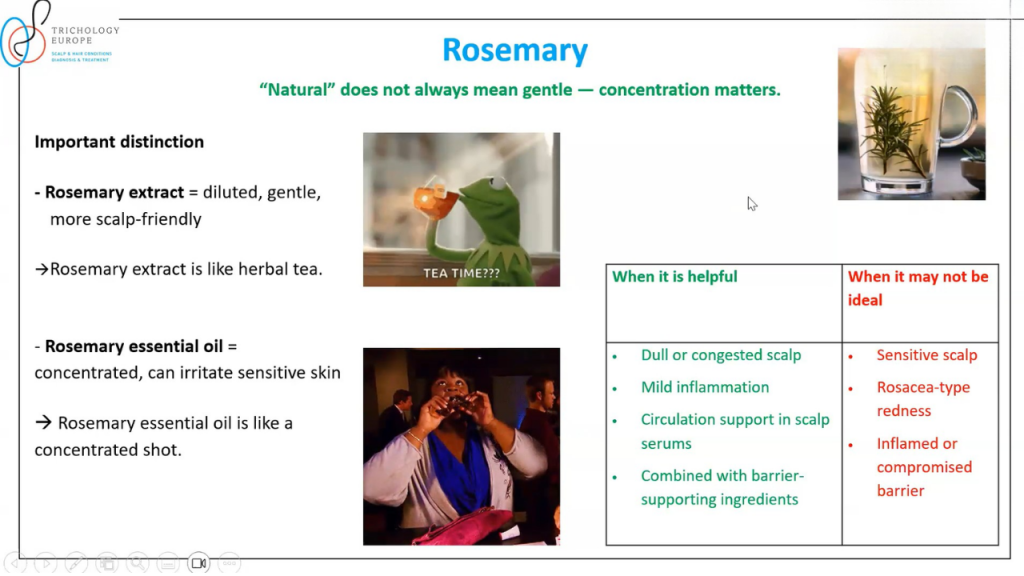
Few ingredients have caused Jacky more work in the clinic than rosemary oil. A small, flawed study has been widely interpreted online as proving that rosemary is as good as, or even better than, 2 percent minoxidil for hair growth. Jacky is direct about this. In her view, the study does not meet the standard of a robust clinical trial. The sample size was too small and the comparison was not valid, making it more like apples versus oranges than like-for-like.
That does not mean rosemary is useless. As an extract in a carefully formulated product, it can have anti-inflammatory and antioxidant properties and may help support scalp comfort and mild stimulation of blood flow. The problem is that many consumers are not buying gentle extracts. They are buying rosemary essential oil, a highly concentrated shot, and adding drops into everything.
Concentration matters. Essential oils are typically used at about one percent of a formula, yet some users are applying them neat to the scalp. Unsurprisingly, this can lead to scalp burns and inflammation. Jacky uses the example of poison ivy to illustrate that “natural” does not automatically mean safe. Many natural substances are toxic or irritating if used incorrectly.
For hairdressers, this is an opportunity to educate. Rosemary can be positioned as a helpful supporting ingredient in a properly formulated product, but never as a replacement for medical hair loss treatments such as minoxidil. Clients should be gently discouraged from applying undiluted essential oils to their scalp, particularly before colour services.
Throughout the session Jacky is clear that hairdressers are not expected to diagnose medical conditions or become chemists. Instead, your role is to spot when hair or scalp are not right to colour, to explain what products can realistically do and to know when to signpost clients to a GP or trichologist.
Colourstart Passport supports that process by providing a clinically proven allergy alert testing framework and a consistent way to record changes over time. When a client arrives with an irritated scalp from home remedies or trending products, having both a structured consultation process and an evidence-based allergy alert test behind you makes it easier to say, “Colour is not the right ervice for you today” and to suggest an alternative service.
In a world where TikTok can promise 48-hour miracles, the combination of scientific clarity and practical consultation approach with Colourstart’s testing platform gives salons a powerful way to build something more valuable than any trend. That is client trust, grounded in safety and honest information rather than hype.